
Architecture & Simplified Process Flow – Deep Dive: The Core Pillars of SAP Master Data Governance :
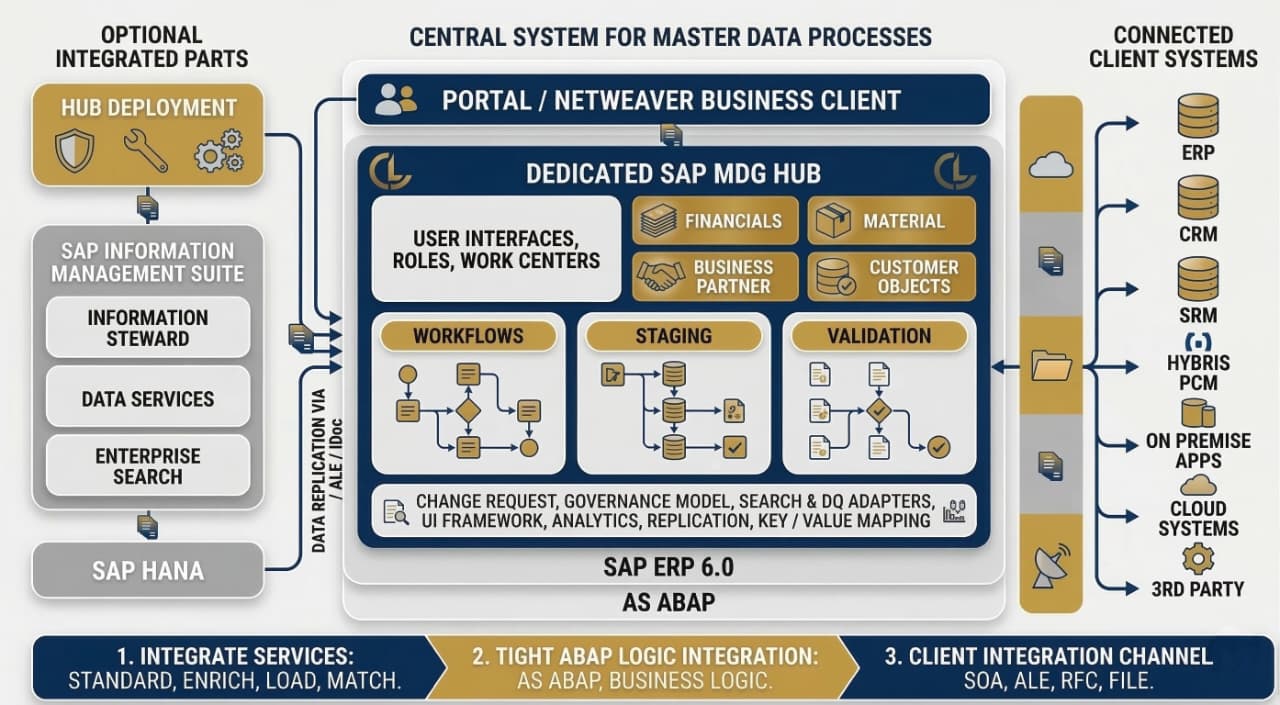
TML #2.1 SAP MDG ARCHITECTURE
Architecture & Simplified Process Flow Architecture & Simplified Process Flow
Understanding SAP MDG architecture is essential for any consultant or architect looking to implement a “Single Source of Truth.” Unlike many external MDM tools, SAP MDG embeds itself uniquely within the SAP ecosystem. It offers a “tight ABAP logic integration” that ensures seamless performance.
1. Technical Prerequisites: The Foundation
To kickstart an SAP MDG implementation, your infrastructure must meet specific baseline requirements. SAP MDG built on the Application Server (AS) ABAP, which requires a minimum version of 7.0. On the ERP side, your system must run SAP ERP 6.0 with Enhancement Pack 6 (EHP 6) or higher. This foundation allows MDG to leverage the core business logic already present in your ERP environment.
2. Out-of-the-Box (OOTB) Capabilities :
One of the biggest advantages of SAP MDG is the “Ready-to-Use” content that comes with the installation. While standard SAP ECC requires extensive custom development for governance, MDG provides a comprehensive framework:
- User Interfaces & Dashboards: Data stewards can access specialized Work Center Dashboards and Change Request UIBBs.
- Roles & Workflows: The system includes prebuilt Standard Roles and Workflow Templates to automate the approval process.
- The Staging Area: A dedicated Inbuilt Staging Area holds and validates data before the system activates it and moves it to the final master data tables.
- Search Techniques: Users can leverage powerful search capabilities, including HANA Search for lightning-fast results or Enterprise Search across the entire landscape.
- Modern Front-End: NetWeaver Business Client (NWBC) or modern SAP Fiori Apps provide a responsive and intuitive user experience.
3. Seamless Integration and Distribution
The ultimate goal of MDG is to serve as the “Central System for Master Data Processes.” Once the system governs and approves data, you must share it. MDG supports a variety of Client Integration Channels to communicate with both SAP (ERP, CRM, SRM) and Non-SAP (3rd Party) systems:
- SOA Services: Modern, service-oriented architecture for web-based communication.
- ALE/IDocs: The classic, reliable method for asynchronous data exchange within SAP landscapes..
- RFC & File Transfers: Flexible options for real-time or batch-based data movement.
4. Optional Enhancements: The Integrated Suite
For organizations requiring advanced data quality management, SAP MDG integrates with the SAP Information Management Suite. These optional integrations significantly enrich your data:
- SAP Information Steward: Provides deep data profiling, metadata management, and data quality monitoring.
- SAP Data Services: Acts as the heavy-lifter for data enrichment, cleansing, and matching during the initial load.
- SAP HANA: Beyond just a database, it powers advanced analytics and duplicate detection within the MDG framework.
The Lifecycle of a Change Request: SAP MDG Process Flow Explained

TML# 2.2 SAP MDG Process Flow
Architecture & Simplified Process Flow Architecture & Simplified Process Flow
To understand how SAP Master Data Governance ensures high-quality data, we must look at the journey a single piece of information takes. The process is divided into three distinct layers that separate the business need from the technical governance and external enrichment.
1. The Three-Layer Architecture
The MDG process operates across three specific environments:
- Business Process Layer: Where the actual business need originates.
- SAP Master Data Governance Layer: The “control room” where the system governs, stages, and validates data.
- External Providers Layer: Where external services (like address validation or credit checks) enrich the data.
2. Step 1: Maintenance (The Requestor’s Role)
Everything starts in the Business Process Layer. An end-user—acting as a Requestor—identifies a need for new master data (e.g., a new Supplier).
- The Requestor logs into the MDG front-end (Fiori or NWBC).
- They maintain details such as Address, Role info, Tax details, and Company Code.
- At this stage, the Inbuilt Staging Area holds the data, meaning it hasn’t yet affected the core ERP tables.
3. Step 2 & 3: Validation and Approval
Once the Requestor submits the request, the Governance Layer takes over using an adaptable workflow:
- Validation: The system automatically checks for duplicates and integrates with External Services for address cleansing.
- Approval: A dedicated validation team or data steward reviews the request. They check for missing information and ensure data accuracy.
- This creates an auditable change process, where the system tracks every edit and approval for compliance.
4. Step 4: Activation and Replication
After the final approval, the system “activates” the data—moving it from the staging area to the active area of the central system.
- Automatic Replication: The system automatically pushes this “golden record” to all Connected Client Systems via SOA, ALE, or RFC.
5. Step 5: Local Adaptation
The journey doesn’t always end at replication. Once the data arrives in a local system, local teams may perform enrichment or add specific details relevant only to that particular region.
The Bottom Line: Why Architecture & Simplified Process Flow Matters
Understanding the layers of SAP MDG architecture is a business necessity, not just a technical requirement. By leveraging embedded ABAP logic and a structured three-layer process flow, organizations move away from “reactive data fixing” toward “proactive data governance.”
When you build a solid architecture and simplify your process flow, you don’t just manage data; you create a reliable Single Source of Truth that powers your entire ERP ecosystem. For the modern enterprise, this represents the difference between operational chaos and seamless digital transformation.
Click here to read our next post : Work Centers and Roles in SAP MDG
Architecture & Simplified Process Flow Architecture & Simplified Process Flow
Architecture & Simplified Process Flow Architecture & Simplified Process Flow